How to Trade on the MarginCall Order Book
Fills come from matching orders, not from a hidden fair value.
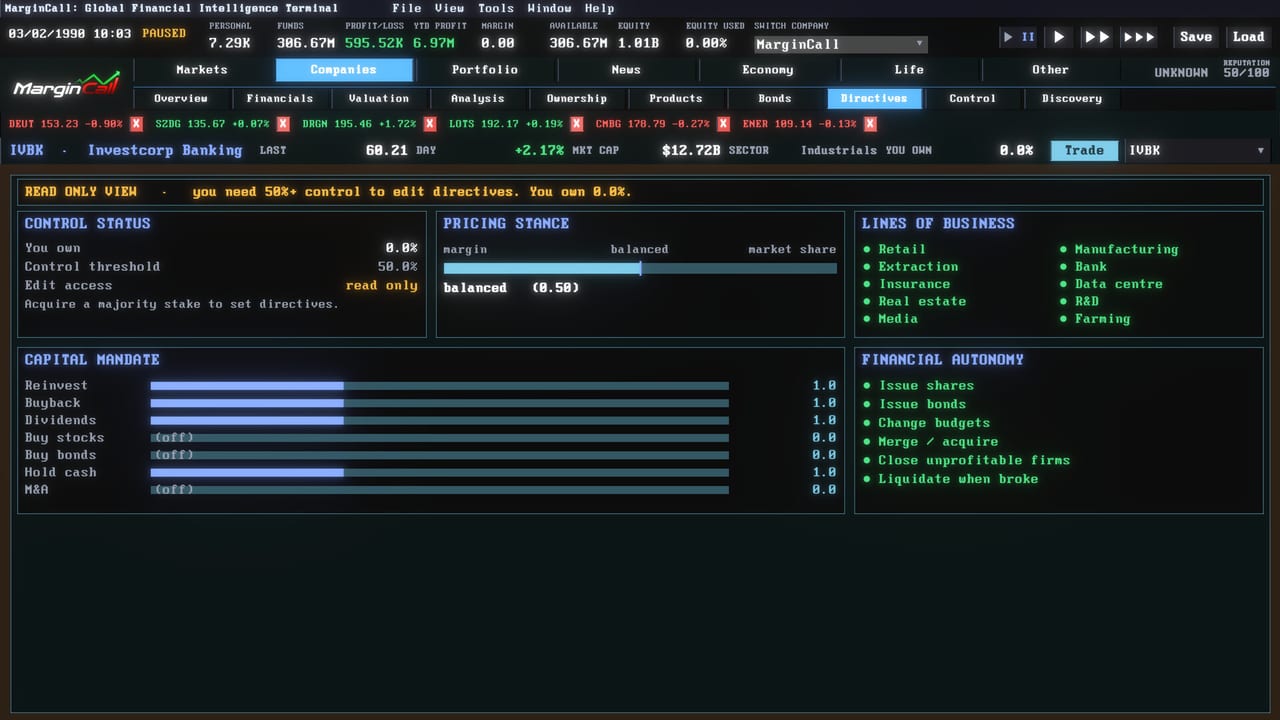
Trading in MarginCall is the act of posting or taking liquidity on a genuine central limit order book. A price changes when two orders match. Every bid needs cash. Every offer needs shares. If you came from a sim that nudges a chart toward a scripted value, this page is the unlearning step.
Steam discussions still ask whether market orders exist. They do. The confusion usually comes from a ticket that also wants a limit price, a stop, or a trailing offset, plus quick-size buttons that used to crowd the quantity field. After a July-era pass, 25 / 50 / 75 percent size sits on its own row so the share count is readable. Use that row. Guessing size from a cramped box is how you buy more float than you meant to.
Order types that actually exist
- Limit. You name the worst price you will accept. The order rests. It may never fill. In a thin book that is a feature.
- Market. You take whatever is on the other side right now. On a name with a tight spread and honest depth, that is fine for small size. On a name you have been cornering, it is how you walk the offer into empty air.
- Stop-loss. A trigger that becomes a marketable order when traded through. Place it before the margin monitor chooses for you.
- Trailing-stop. The trigger follows a favourable move. Useful when you are right and still want a fuse.
Long, short, and hedge all sit on the same machinery. Shorting needs locate and borrow. As you buy the tradable float, the footer shows Avail as a percentage and can flag Hard to Borrow. Resting offers thin. Market-makers can no longer conjure infinite sell-side size. That is the squeeze setup, not a bug.
Worked examples and a compact chooser live on the order types tool. Come back here when you need the why.
Reading the book instead of the last print
Last price is a tombstone. Depth is the living thing. Watch:
- Spread widening when everyone heads for the exit.
- Size pulling from the offer as a squeeze develops.
- Slippage on a marketable order that looked cheap in the last-print column.
- The tape. A hotfix stopped the tape from printing endless fake volume after you owned the public float. If the tape still looks bottomless, you are probably not as cornered as you think.
Quick-size is not a thesis. Twenty-five percent of a huge cash pile into an illiquid name is still a huge order. Check Avail first.
Positions, P/L, and the questions people actually ask
The Positions page now shows realised P/L, with dividends both inside that figure and listed on their own. Options and futures belong there too. Holdings in the Markets tab show date acquired and income. Open-position rows gained a Close button that does not flash. If a bought name such as an SMP 500 product is missing, check whether you bought a fund, a future, or a cash equity, then look at Positions versus Markets before assuming the fill vanished. Launch-week threads still report portfolio ghosts; we log those on known issues.
Stops and take-profit handles can be dragged. If you cannot find live P/L on the ticket, look at the open-position strip and the thesis panel, which now keeps cost, P/L versus fair value, and your written stop.
Markets beyond cash equities
The same ticket logic appears on commodities, FX, and futures, with an affordability check before fill so a thin market cannot print a violent one-tick jump on a single trade. Futures can cash-settle or take physical delivery when the contract allows it. Written options can be bought back even when spare cash is tied up as margin, which matters when a short option is the thing killing you.
Earnings still print. Some players wait for the report and lift options immediately because bots are slow. That is a documented exploit, not a strategy we recommend as a lifestyle. If you use options, know the chain, the expiry, and the fact that splits now flow into options and convertibles instead of wiping them.
A trading loop that survives
- Scan with the rebuilt terminal: headline figures first, then statements.
- Write a note with conviction, target, and stop.
- Choose the order type on purpose. Default to limits until you can explain why a market is safer.
- Size from Avail and from the margin calculator, not from boredom.
- After the fill, manage with trailing logic or a hard stop. Do not wait for the monitor.
When you want factories instead of fills, switch to How to Run Production. When you want the CEO chair, open How to Take Over Companies. The book will still be here when you come back, and it will not care which fantasy you picked.
Frequently Asked Questions
Direct answers drawn from the same mechanics this wiki covers in depth.
Does MarginCall have market orders?
Yes. Use them on liquid names with visible depth. Prefer limits when the book is thin or you are walking size.
Where do I see realised profit?
On the Positions page. Dividends are included in realised P/L and also listed separately.
What does Hard to Borrow mean?
The tradable float is nearly gone. Offers thin, shorts get expensive or impossible, and a squeeze becomes more likely.
Can I short, hedge, and trade options?
Yes. Options and futures appear on Positions. Written options can be bought back even when cash is posted as margin.